Showing posts with label learning commons. Show all posts

Saturday, June 8, 2013

The Mansfield Trip

Here are a few photos from the Mansfield trip which by all accounts was a total success. Kids said they truly enjoyed the trip. We had cool weather and then brutally hot weather but fun was had by all. Some students slept outside on the final night on their porches. The stars were awesome that night. Thanks so much to the students for making it such a fun trip your laughter certainly brought me joy.

Investigating creatures at the pond

Searching the whole pond

Playing Instincts for Survival in the woods

Playing Hucklebuckle

Low Ropes Activities in the Barn

Getting Right in the Pond

Foot to Butt in Huckle Buckle

The Pond is filled with Tadpoles and Newts

Teachers were hunters during Instincts

Wednesday, May 29, 2013

Grade 7 and 8 Overnight Trip to Mansfield Outdoor Centre

So students are about to embark on a three day, two night trip to Mansfield Outdoor Centre, which is located just 1 hour from Toronto in the beautiful area of Mulmur. Students will be staying in the cabins at the Main building and will be participating in a variety of outdoor based activities. Essentially, our students will be coming to a traditional kind of summer camp, only we're going during the school year.

I believe strongly in the value of getting kids outside and having them experience nature, learn and be connected with their world. Once you get them outside and experiencing and learning they love it and become even more curious. Richard Louv author of the "Last Child in the Woods", discusses the importance of kids gaining independence and getting outside.


These types of activities are so important for our kids. Firstly, many of our kids never get to come to a place like Mansfield and experience the outdoors. So many of my city kids have no idea what it's like to spend 24/7 outdoors, in nature.

When we come here kids  get an opportunity to explore the nature. We give them freedom within a set of boundaries. For instance, during free time kids can go and explore the area as long as they see the main building at all times. This rule allows kids to explore approximately a 4 or 5 acre area while still being within eyesight of our home base. The kids play soccer, basketball, volleyball, etc. They explore the fields. I make the rule that students can climb trees as long they stay on branches that are thicker than their wrist. The reality is they never really get very far off the ground but it feels like a huge freedom. So many of them have never climbed trees before. Last year we taught a group to make a horn noise by blowing on thick pieces of grass. Some of them were so entertained by this they spent the whole week playing with grass horns.

The programs we participate in are also extremely valuable. Kids, participate in pond study, where they investigate pond creatures, or they complete orienteering maps and explore the forest. They learn about nature through experiential education.


I'm truly looking forward to this trip and can't wait to see what happens.

Wednesday, April 17, 2013

Education Week and The Activities here at Lagerquist!

Education Week is quickly approaching and I find myself rushing to put together this post. I want to inform everyone of all the different activities that will be occurring here at Lagerquist. There are a lot of staff who have worked very hard to put together a variety of different activities for our students.

We decided to go with the theme.

Explore!

Our Hope was to present students with lots of opportunities to Explore information they wouldn't normally be able to experience during a normal day at school. 

So here it is.... Our Education Week line up. 


Explore Birds of Prey-
The Canadian Raptor Conservancy will present in the gym on April 23rd (presentation takes place in the gym)


Explore the Past-

Guess which baby picture belongs to which teacher. Guess them correctly and win a prize (pictures are located in the downstairs hallway)


                                          Explore Music-
Monday April 22 the beatboxing string trio Infinitus will perform in the gym.


Explore Human Experience-
Discover the human side of your teachers! Hear fascinating stories!
 Learn about the variety of human life! (Human books will be read in the library. Students can sign up for different books)


Explore Ideas-
Listen to your classmates present their thoughts during the speech competition (Speeches will be presented in the library)


Explore French- Listen to and look at French Speeches, Skits, and eBooks– all created by Lagerquist students! April 26th (find the cafe located upstairs in the library)


A Water Story using Waterlife and Storybird!

Recently, several classes of grade 8 students visited the library in order to research water. They were interested in topics like water pollution, water use, the water cycle and the belugas whales in the St. Lawrence River.
Mrs. G. Singh and myself first discussed the project approximately two months before students were to arrive in the library for research sessions. Last year we utilized a Web 2.0 tool called Storybird.  It's an easy and versatile site that can be used for all sorts of activities from creative writing to writing non-fiction picture books.
Mrs. Singh and I came up with a set of criteria for the kids and tried to build on the project from the previous year. This year we added some time to research water issues using the National Film Board site called "WaterLife" Students were given a graphic organizer called "A Gem of an Idea". I've Included an image of the organizer here along with the instructions for using it.

The students spent two classes searching through the website writing down interesting facts and sharing this information with their peers by creating graphic organizers about water. Here are some examples. 


Students were then instructed to come up with some ideas for writing a story that would explain what they had learned about their chosen water topic. We discussed main ideas and themes and then students wrote a short organizer and began creating their stories on Storybird. The paid version of Storybird allows you to print out the stories as PDFs. We utilized the free version of Storybird.


Here are some screen shots from their Stories. This first story is an example of some of the topics and images available on Storybird. The idea behind Storybird is to take inspiration from the pictures available. Part of our struggle is to show the kids that their story needs to evolve from the images. Some students do struggle with this. We are lenient in that in the case of the story below this is a killer whale image not a Beluga.
This story discussed Beluga whales. 

Here's a second example. Again I'm showing just the cover page and one page from inside the story. 


The students seemed to enjoy this project and gave us lots of good feedback. The advantage to this project was our ability to combine language skills with research for science. In the end it was an effective way to integrate subject matter. 


Tuesday, April 2, 2013

Grade 8 Cell Projects

Three classes of grade 8's recently visited the library in order to complete a research project for science class. They were learning about various types of cells. Students were expected to work with a partner to research a particular type of cell and then create a presentation which would explain their learning to other students in their class.

Mr. Warr and I worked to coordinate class time for students to complete the projects. I then helped Mr. Warr to introduce the project. We discussed with the students the importance of taking good jot notes so that the information would be easy to utilize when creating their presentations. Students were given several options for creating their presentations. Some utilized PowerPoint or the free version of PowerPoint called Open Office. Most decided to utilize PowerPoint. Students were required to completed a project in which they researched the life cycle, and the anatomy of a particular cell.


They utilized our digital library, print resources from our non-fiction collection and also other websites from the internet. For this project Mr. Warr and myself decided to use the mobile WiFi cart. We learned a great deal during the implementation of this project about the use of our mobile cart. Here at Lagerquist our mobile WiFi cart contains 12 iPads and 12 Netbooks. Students can access and use the cart in their classrooms. At first the use of the cart for research was difficult to master. Mr. Warr is admittedly not tech savvy and required a considerable amount of assistance with in utilizing the cart for the completion of their projects. The iPads were more awkward to use because the could not utilize PowerPoint on the iPads so we had to coordinate who was using which device. Also, the Prezi app on the iPad did not have many of the capabilities of the desktop version of Prezi so this made it difficult for students to utilize. However the students and myself worked around these limitations and overall the projects were very successful. We have learned that there are limitations to the usefulness of the iPads. The Netbooks are certainly useful for certain types of assignments and the iPads have their place in the creative realm for producing things like music, videos, photography and certainly surfing the web. The most effective projects were completed using Prezi. I've included a link to this Web 2.0 tool here. I've also added this little YouTube video that explains how Prezi works. It's a fantastic tool.


Monday, February 11, 2013

The Twits by Roald Dahl and using Imovie to Summarize!

Having recently purchased Imovie for our iPads, Mrs. Camarda and myself decided to utilize the pre-made trailers within Imovie as a tool for teaching students to summarize a novel. Mrs. Camarda utilized an audio book version of "The Twits" by Roald Dahl to read the story to students, in class. They then completed several comprehension activities with in the classroom.
Mrs. Camarda and I then sat down to plan how we would introduce the idea of creating a movie trailer to the students. We decided to have the students create a storyboard that showed, in detail each scene they would film. We asked them to think about the important events in the book and how those events would look were you to view them in movie format.  Each trailer comes pre-made with background music and captions which students could edit. The students were told to choose a particular style of trailer and then to plan out their scenes using the storyboard we provided to them. Students were given two periods to create their storyboards and to plan out their props, etc.
The filming was completed in the library. The different groups were able to spread out and utilize different areas of the library for their scenes. Many of the students created some pretty impressive props which included wings for the bird and a real pie. Students were then given three class periods to film their scenes, and edit their work. Students were very excited about the project and worked well with each other. They began to get creative with their work. In one instance students made balloons out of construction paper then laid them on the floor and a student pretended to hold on to them to create the appearance that he was flying. Other students utilized the screen shot feature in the iPads to take images from the web, edit them using our photo editing app, then insert these images into their trailers. One group asked to utilize an app that puts beards on people to insert an image of Mr. Twit into their work. There were very few conflicts, etc.
The end result has been extremely positive. The trailers are well done and students have shown a general enjoyment of the project.

We asked several students what they feel they have learned from this project. The following are direct quotations from the students.

"I learned that in a group you can't use all of your own ideas you have to compromise."
"Things have to get cut out sometimes or changed if you want to finish the project."
"There's a lot we can do with an iPad."
"Summarizing is hard you really have to focus on the important parts because not everything can fit in the trailer."

Mrs. Camarda and I talked about these comments after the students had left and we were impressed with their perceptions of the learning. They weren't interested in reciting facts to us rather the students mentioned learning life skills like creativity, flexibility and the ability to cooperate. We feel the project has been very successful and hopefully we will post several of the trailers here for people to view.

Friday, January 18, 2013

Forest of Reading - An Update!!!

There's so much going on at school right now. The library has been booked solid for the last three weeks.  The Forest of Reading has been incredibly successful. I ordered a total of 80 books for just the Red Maple category of the Forest of Reading and right now all 80 books are checked out. In total I purchased 170 titles for the Forest of Reading. I have kids requesting copies left right and centre. I've included a link to the Forest of Reading brochure. People can access and see all the categories and all the titles in Forest of Reading. If anyone were to donate some of these titles particularly the Red Maple category, that would be fantastic:))

The Forest of Reading has been very popular this year. I currently have 176 students signed up to participate in the voting, for the winning books. This is a huge number. I certainly didn't anticipate having this many students interested in the program and am feeling a little overwhelmed by their enthusiasm.

Students can participate in the Forest of Reading in a number of ways. My goal was to make the program accessible to everyone and make it easy and fun to participate. I would like to see every student in the school pick up a Forest of Reading book sometime during this year and enjoy reading it. If students do this then I will consider the program to have been a success. Of course this isn't the only thing going on students have the following options for participation.

  1. Read any of the books for enjoyment.
  2. Read any of the books for enjoyment then speak to one of the participating teachers about what they have read.
  3. Read any of the books and come to book club on Tuesdays or Thursdays. 
  4. Write a message on the Graffiti board. 
  5. Rehearse and discuss their book while I film them for our Forest of Reading video.
  6. Read 5 books from one of the categories and document their reading on a passport, then participate in the voting at the end of April. 
I want students enthusiastic about reading and enjoying what they read. I believe that literacy is best promoted through positive encouragement.Students all read at different levels so it is important to make the books and success accessible to all. Hopefully, the variety of options that I have presented to students will encourage them to keep reading and above all enjoy it.  

Wednesday, January 9, 2013

Bitstrips for Schools and Learning French!

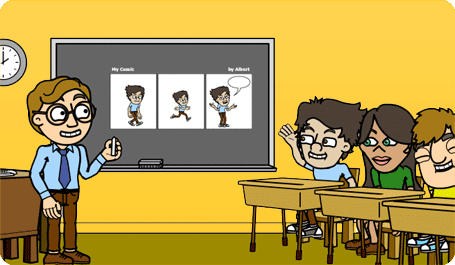
Part of my job here at Lagerquist is to work as a resource person for other teachers. Part of my job is to have a fairly wide base of knowledge about technology, curriculum, and teaching strategies. Hopefully, I have fulfilled this role by helping Mrs. Albrecht to plan and learn how to use Bitstrips for Schools. Bitstrips for Schools is a fantastic little resource which allows teachers to create virtual classrooms and structure assignments for students in which students create comic strips to display their learning. Mrs. Albrecht has chosen to have students create a comic strip for her grade 7 french class.

Here's a link to a video about Bitstrips. Bitstrips on Vimeo


Mrs. Albrecht came to see me in December to discuss the project. She wanted to try and add a technology component to her french program. She admits to not having a strong knowledge of technology but very much wanted to try a new activity and to learn some more about technology. I took her to the Bitstrips website and showed her all the features available on the site. We talked about setting up an account for each students. This is a fairly daunting task as Mrs. Albrecht has 6 french classes and it was a going to take a fair amount of time to set up individual accounts for approximately 150 students. She was committed to the project however and seemed very eager to start setting up the virtual classroom. Mrs. Albrecht was fantastic she was open to suggestions and really wanted to learn. We discussed the length of time it would take to introduce the program to the kids, get them set up and then an appropriate amount of class time for the project. We booked the students into the library computer lab for 3 periods for each class. It was refreshing to discuss a french project with her as most activities I work on are science, history or language based.

The assignment required students to use their reading comprehension skills to read a collection of sentences and choose 15 sentences to order into a cohesive story. Students were then brought to the library and I instructed students on how to use Bitstrips. Students were given the option to create an electronic comic or a hand drawn version. Most students chose the electronic option. Bitstrips is fantastic because students can also access their virtual classroom from home. This means that most students can complete their work here at school or at home. For those with limited Internet access Study Hall provides that extra time to work on computers.

It's been a lot of fun working with Mrs. Albrecht and her 6 classes of french. I look forward to another partnership in the near future and will certainly post some of the students comics as they complete them.


Sunday, January 6, 2013

Getting Back into the Swing of Things

The holidays are coming to a close and it's time to start fresh with new energy and enthusiasm for the New Year. Despite the current political climate I'm looking forward to seeing the kids and hearing about their holidays. Many of them will have some pretty silly stories to tell and I will share a little of my holiday with them. It will be good to touch base again and see them smile as they walk through the library door. That's one good thing about all this. We adults will get caught up in the money and the politics, the kids will stay kids regardless. The reality is they just want to have fun and learn. I plan on focusing on that. What else can you do?

So what exactly did I do with my holidays? Well......

  1.  I took a bunch of days and just had fun with my own kids. (They don't call it holidays for nothing)
  2. I hosted Christmas dinner for 28 family members. ;))
  3. Just before the holidays we purchased several apps for our iPads. I brought home one of the iPads and spent several days teaching myself how to use the apps. Using resources from YouTube, the web and of course my own kids. I taught myself how to use Garage BandBook Creator, and I movie. It was a lot of fun. We created some pretty silly books, movies and music. 
  4. I created a schedule and sent emails to colleagues about scheduling classes into the library space for their introduction to the Forest of Reading.
  5. I read several blogs on technology and teaching. Just hoping to stay up to date. 
  6. Enrolled in a photography course and set up a photo website.
  7. Sketched out my photo ideas for an upcoming cover I'm going to shoot for the Library Association's Teacher/Librarian magazine. 
  8. I read three books for our upcoming Forest of Reading program.

To date I have finished....
 The Tiffin - a story set in Bombay, India which chronicles the quest of one young man to find his mother and his family.


All Good Children  - is a dystopia story about a boy living in New Middleton with his mother and sister. In this story kids are being given drugs that make them behave. No nagging, whining, etc. kids are perfect. It's a parents utopia, no more disobeying. (Sounds good right!!)


This Dark Endeavour - is a remake of the Frankenstein story, sort of. This novel tells the story of Victor Frankenstein as a young man. In essence it's a prequel to Mary Shelley's story.


I really tried to balance school work with pleasure. Yes the books were for work but I do love reading so it's a double whammy of sorts. Several other teachers also took home books from the Forest of Reading. These teachers will be available throughout the next few months to talk to kids about the different books, to hear their opinions about the various books. It will be a lot of fun and kids really do enjoy talking to us on a sort of social level.
Playing around with the various apps was also a lot of fun. We made some pretty silly movies with the app and I'm tempted to post the movie here but it really is just absolute nonsense and I'm not sure that everyone will enjoy watching as much as we did making the movies.


Hopefully, everyone has a had a great holiday and enjoyed their time at home. I look forward to a lot of great experiences here in 2013. :)))

Thursday, December 20, 2012

Finished Aboriginal Projects

I would like to display some of our finished projects from the grade 6 aboriginal peoples unit. Please see the blog entry entitled The Actual Assignment Pages to refresh your memory as to what the assignment entailed. Students were very enthusiastic about the assignment. They worked hard to complete the assignment and worked well together. Mrs. Camarda and myself worked hard to have to students conference with each other in order to ensure that each part of the assignment was completed. I have included samples of the students work below.

  1. The Cree - this is a power point presentation which has been uploaded to a Google drive file. 
  2. The following images display the models of traditional aboriginal wigwams, teepees, longhouses, etc.
Wigwam

A Salish house

A Longhouse

A teepee

Salish Longhouse

A Wigwam

The whole collection


The following images show some of the display boards that students created for their presentations.
A Story board for an Iroquois Creation Story


A presentation board on the Blackfoot

All about the Iroquois

A drawing of a teepee that explains different parts of the structure

All about the Salish
Mrs. Camarda and I consider the project to have been quite successful. The students have learned a great deal. They were able to be creative and  appeared to enjoy the work. They were enthusiastic and confident when they presented to their classmates. This is the first time that we have run this particular project with the students and Mrs. Camarda and I will discuss some things that we plan on changing in the future. This however is what teaching is all about. We learn just as much as the kids do each time we prepare and present a unit. Sometimes the manner in which a project is introduced is changed or the order in which the background information is changed. Each time a unit is taught there are always little changes or tweaks for the better. Teachers analyze and assess the effectiveness of a given unit and then work towards building it into something better each time it is taught. 

Friday, November 23, 2012

School Library Staffing is on the Decline

In an earlier entry I discussed staffing and formulas used to decide just how much staffing a school library receives  The reality is that funding for school libraries is in heavy decline. Funding for libraries has been decreasing. Statistics and many different studies say this is a bad thing. A recent article by CBC News discussed a report by People for Education. The report discusses the decline of school libraries and the important role libraries play in student success.
The report by the group People for Education found 56 per cent of Ontario elementary schools in 2010 have at least one full- or part-time teacher-librarian, an accredited teacher who has library training. That's down from 80 per cent in the 1997/1998 school year, according to the report, which was released Monday morning.
Meanwhile, 66 per cent of secondary schools across the province have at least one teacher-librarian, down from 78 per cent in 2000/2001, when the group first started tracking data for high schools. CBC News
Libraries play an important role within the school. It offers a place for work to be completed, literacy to be encouraged and perhaps its most important role is as a support resource role for teachers. Quite often I meet with teachers to discuss teaching strategies and ideas for promoting literacy and content understanding, in their students.

Annie Kidder from People for Education also sites the importance of Libraries in helping to improve student achievement.

Teacher-librarians play an important role in helping children find information, evaluate and thinking critically about it and then applying it, said Annie Kidder, the executive director of the group in an interview.
"These kinds of skills that sort of help kids in what we are calling these days the knowledge economy are incredibly important," she said.   

When I first arrived at Lagerquist,  9 years ago, as a classroom teacher we had a full time Librarian who supported teachers through many different initiatives including the Forest of Reading and a research skills program. She was reduced to 80% the following year and then as years passed the job was again reduced to 50%. It was only this past year that the allocation was increased due to the arrival of grade 6 students at our school.

The state of our library is pretty good all things considered. We have new computer and work tables as well as well as Wi-Fi and a full computer lab available right in the library. We have a supportive principal who believes in the importance of a library and she has given me a lot of freedom to encourage use of the library. Students are free to visit during the day to complete work and to utilize technology. We are extremely short on books though. We're about 1000 titles short for a school our size but fundraising efforts are helping this. Visit our adopt a school site. I enjoy having the library open as much as possible in order to help students and teachers. I notice an excitement in the kids when we discuss books and kids are flocking to the technology we are offering students in the library.

There are many schools that can't say they have this much, I know that but this doesn't mean we can't keep building towards something even better. This is my goal to build up the library to make it the hub of the school.

Tuesday, November 20, 2012

Questions and Answers about Staffing the Library here at Lagerquist

Currently, here at Lagerquist our library is staffed for 80% of the day. I am a part time teacher/librarian. I want to make it clear that this is not about me bargaining for a full time position. In fact I dropped down to 80% 4 years ago in order to take care of my young family. Should our library be staffed full time. Yes! I believe it should but this of course is not in my power to change. This is blog is about giving clear information about how much our library is available to students under our current staffing allotment. 


Why is our Library not open full time?
The amount of staffing for each school library is based on student population. Here at Lagerquist our student population is approximately 650 students. As such, we fall into the 80% staffed library formula. If we were to have less students our library staffing would diminish. If we had more students our library staffing would increase.

How does one calculate the amount of time the library is staffed in a day cycle formula?
Here at Lagerquist our cycle has 24 instructional blocks which works out to 4 periods per day on a 6 day cycle. An 80% allotment means the Library has 15 periods available as teaching/staffed period and 3 periods for teacher planning time, totalling 18 periods out of 24. 

What does this look like in terms of open library doors? 
On paper the library is open from 9am to 1:30pm daily. I do not close the library for my planning times, in reality I don't take them. I also staff the library beyond my allotted contract. Our library does not close at 1:30pm I stay for an extra half hour daily in order to keep the space open for as long as possible. 

This means the library is open as much as possible which I feel is extremely important to the success of a library, in the school environment. Students need to be able to drop in and utilize the resources in the library when they need them. Students have not perfected the idea of planning ahead and working within a time frame. Plus you never know when you might need something. 

What services does the Library offer? 
One of the services I offer is Study Hall which I run on my own and of my own volition. I open the library for 3 lunch hours a week in order for students to have access to computers and workspaces they may not have at home. They use the time to finish up homework, to exchange books, to read quietly, to study for tests, to utilize items they cannot sign out like class reserved print resources, Ipads or netbooks. The rule of Study Hall is you must be working on something. Students use Study Hall regularly I often have between 30 and 40 students in the library on an given lunch hour.

Is Study Hall considered a part of the 80% staffing? 
No it is not. Study Hall is an extra that I run because I feel it is important and in reality a part of the unwritten job description of a library. Libraries should be open and available to students when they need it. 

Hopefully, this gives you a better picture of how much our library is open and available to students. In upcoming blogs I will discuss more of the programs we offer, how study hall works and it's benefits, the Forest of Reading program will begin running in the near future and lots of other activities that will occur here in the library.    

Wednesday, November 14, 2012

What Does a Teacher/Librarian Actually Do?

What Does a Teacher/Librarian actually Do?

Good question! 
A lot of people ask me that and some people make assumptions about the job. Others just have no clue and well lots of people don't like libraries so they don't care. They see the stereotypical library where the librarian is crabby, grumpy and insists on complete silence.

Kind of like the image you see here.

This is the way lots of people picture us. Talk about  stereotypes.


Television shows and movies enforce this stereotype. If you have the time there's a whole you tube series on librarian stereotypes. You can find the link to the first movie in the series right here.

So lets dispel some myths. Lets talk about what I really do. In another entry I'll discuss the grand vision for this library. So let's stay focused on the job itself, at least for today. Please keep in mind that there is a significant difference between Teacher/Librarians and Public Librarians. Teacher/Librarians are teachers who operate libraries located in schools and have a teaching degree with a Library qualification. Public Librarians have library sciences training from a college or university. My list discusses the role of the Teacher/Librarian. Depending on the person and the school this list may vary. The list is a description of what I do on a daily basis others may have different items on their list but it would be similar to my own. 
  1. Keep staff up to date with available programs for student learning.
  2. Run library orientations, at the start of the year in order to familiarize students with the resources available. 
  3. Collaborate with teachers and help them to build research unit for students.
  4. Manage the library collection. This includes purchasing, weeding out damaged or out of date books.
  5. Create and implement programs which promote literacy like the Forest of Reading program.  
  6. Provide assistance to teachers when planning units.
  7. Provide staff with resources for the classroom.
  8. Provide a schedule of available times for book exchange, teaching periods, etc.
  9. Work with teachers to coordinate optimal use of library time.
  10. Run a library leaders program that involves students in the maintenance of the library collection.
  11. Instruct students on techniques for successful research projects.
  12. Consulting with teachers in order to provide teachers with materials for their classrooms. (For example, I recently put together a collection of Gothic novels and Frankenstein resources. A teacher is planning on using these resources for her novel study unit.)
  13. Keep the printers supplied with paper.
  14. Manage overdue lists. This includes following up with students at the end of the year and getting them to pay, for or replace lost and damaged items.
  15. Maintain the library lab which is usually a bank of 25 to 30 computers. This includes calling techs. for repairs and managing the network. (note: not all librarians have this added position. Some libraries don't have labs)
  16. Catalogue and shelve library materials. 
  17. Provide work spaces for students to complete work.
  18. Assist students with finding resources within the library and on the web.
  19. The list is endless I'm pretty sure I could list 50 more things but I'll stop here before this entry gets too long. 

I would like to end this entry with a different image of a librarian. 

For orientation this year, I created an avatar of myself and posted it for kids to view. I used a website called The Hero Factory. The kids thought it was pretty funny and wanted to know how to use the site. Some have since made characters and are using these characters for creative writing projects. 

Gone (I hope) are the days of the stiff, unforgiving, cranky, nerdy librarian. I want everyone to view the library space as a hub of activity in which the space reflects the needs of the student body. The library should encourage students to read for pleasure and for learning. 

I want students here researching, practicing drama skits, utlizing technology to build a presentation for class, and 100 other things. 

This library and many others like it should be a place where kids love to learn.